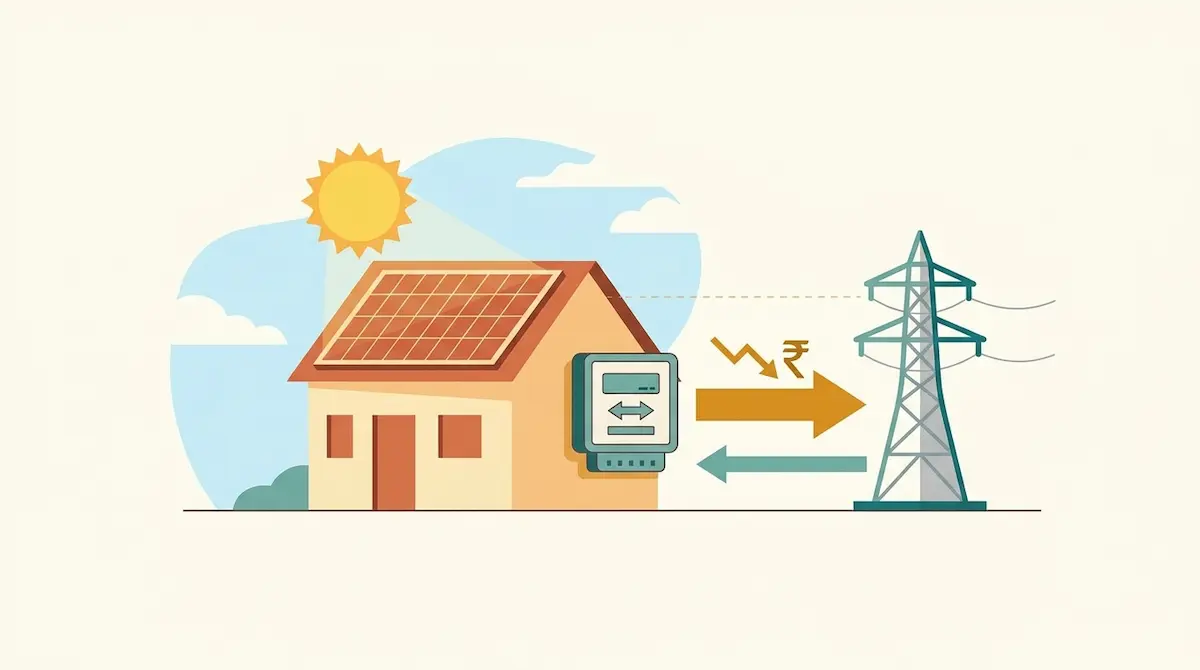
If you are planning rooftop solar in Multan, Bahawalpur or anywhere across MEPCO’s South Punjab network, the rules you were counting on no longer exist. On 9 February 2026, NEPRA notified the Prosumer Regulations 2026 and repealed the decade-old net metering framework from 2015. New solar consumers now fall under net billing, not net metering — and the difference is large enough to change whether a system pays for itself.
Here is what changed, who it affects, and how to size a system that still makes sense.
Net metering vs net billing — the one change that matters
Under the old net metering system, the meter ran both ways at the same value. Every unit you exported to the grid offset a unit you imported, one for one. Export 300 units, import 300, and your energy charge was effectively zero.
Net billing breaks that link. Your exported surplus units and your imported units are now priced separately. You still send extra daytime generation to the grid, but you are paid a fixed buyback rate for it — while you keep buying grid power at the full retail tariff.
The new buyback rate for MEPCO prosumers
For new connections, NEPRA set the buyback rate at the national average energy purchase price, currently around Rs10–11 per unit. That is down sharply from the roughly Rs26–27 per unit net metering paid. The grid electricity you import is billed at your normal slab tariff, which can sit anywhere from about Rs37 to Rs55 per unit depending on your category and consumption.
That gap is the whole story. Every exported unit earns you about Rs11; every imported unit costs four to five times more. Overproducing to “sell to the grid” no longer adds up.
What else the Prosumer Regulations 2026 changed
A few structural changes sit alongside the rate cut:
- Contract term cut to five years, down from seven, renewable only by mutual consent with your DISCO.
- System size capped at your sanctioned load — you can no longer install capacity beyond what your connection is approved for.
- Quarterly settlement — if the value of your exports exceeds your imports, the surplus is either adjusted in your next bill or paid out every three months.
- The rules cover solar, wind and biogas systems up to 1 MW, with bi-directional metering required.
If you already have net metering, are you affected?
No — your existing contract is protected. After Prime Minister Shehbaz Sharif intervened and the Power Division asked NEPRA to reconsider, the regulator amended the Prosumer Regulations 2026 to grandfather existing prosumers. If you held a valid net metering agreement on or before 9 February 2026, you keep your old terms — the roughly Rs26 per unit rate and one-to-one unit exchange — until your current seven-year contract expires.
After expiry, renewal falls under the new five-year net billing framework, subject to your DISCO’s agreement. So the protection is real but time-bound: plan ahead for the day your contract runs out.
There is also relief for those caught mid-process. Power Minister Awais Leghari confirmed that 5,165 applications filed before 8 February 2026, covering about 250.8 MW, will be processed under the old net metering policy. Anyone applying after 9 February 2026 is fully under net billing.
Does solar still make sense in South Punjab?
Yes — but the math now rewards self-consumption, not export. South Punjab’s long, hot summers mean heavy daytime cooling load, and that is exactly when your panels generate most. A system sized to run your air conditioners, water pumps and appliances during daylight — rather than to dump surplus on the grid at Rs11 — gives the fastest payback.
Three practical adjustments for new installations:
Size for daytime use, not export
Match your array to what you consume while the sun is up. Units you use directly are worth your full retail tariff in savings; units you export are worth about Rs11. The closer your generation tracks your daytime demand, the better the return.
Consider battery storage
With buyback rates this low, storing surplus for evening use often beats selling it. Batteries add cost, but they let you self-consume power that net billing would otherwise undervalue — and they cushion you against load shedding.
Stay within your sanctioned load
Because capacity is now tied to your sanctioned load, confirm your connection’s approved limit before quoting a system. Oversizing no longer helps and may not be approved.
The bottom line for MEPCO consumers
Net metering as a one-to-one savings engine is over for new solar users in MEPCO areas. Net billing pays far less for exported power, so the win comes from using what you generate, not selling it. Existing prosumers keep their old deal until their contracts end; everyone else should design around self-consumption and storage.
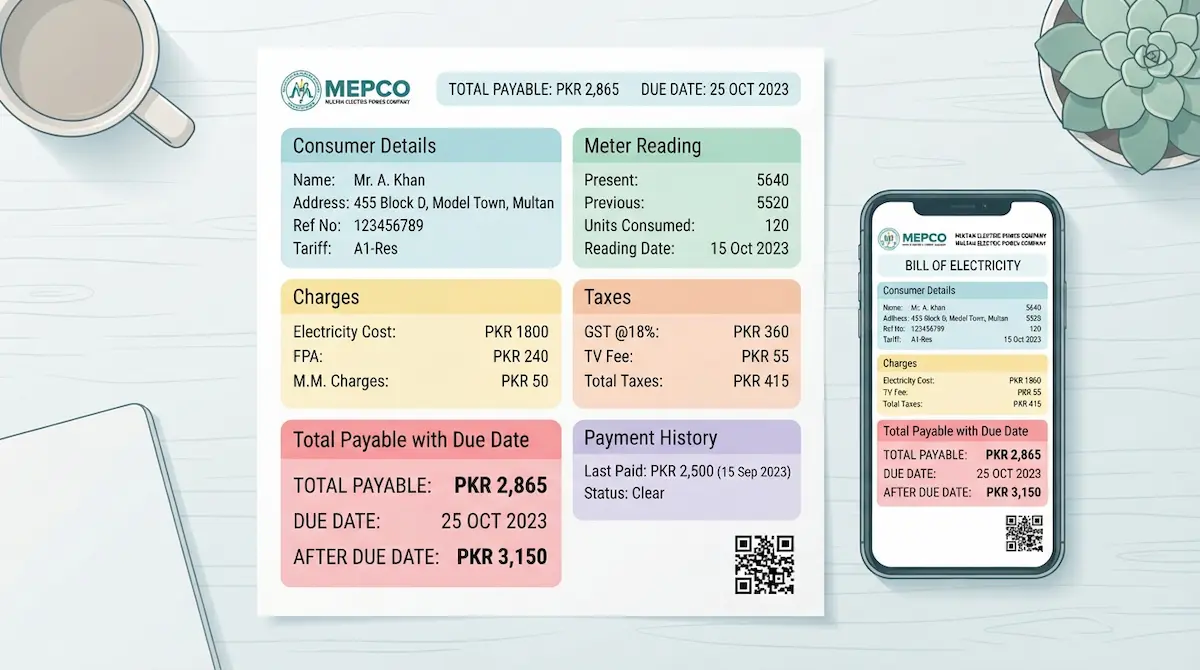
Whether or not you go solar, watching your monthly usage is the simplest way to control costs — you can view your current MEPCO bill any time with your reference number, and it is worth reading alongside the recent June 2026 tariff adjustments that affect every consumer’s per-unit rate.