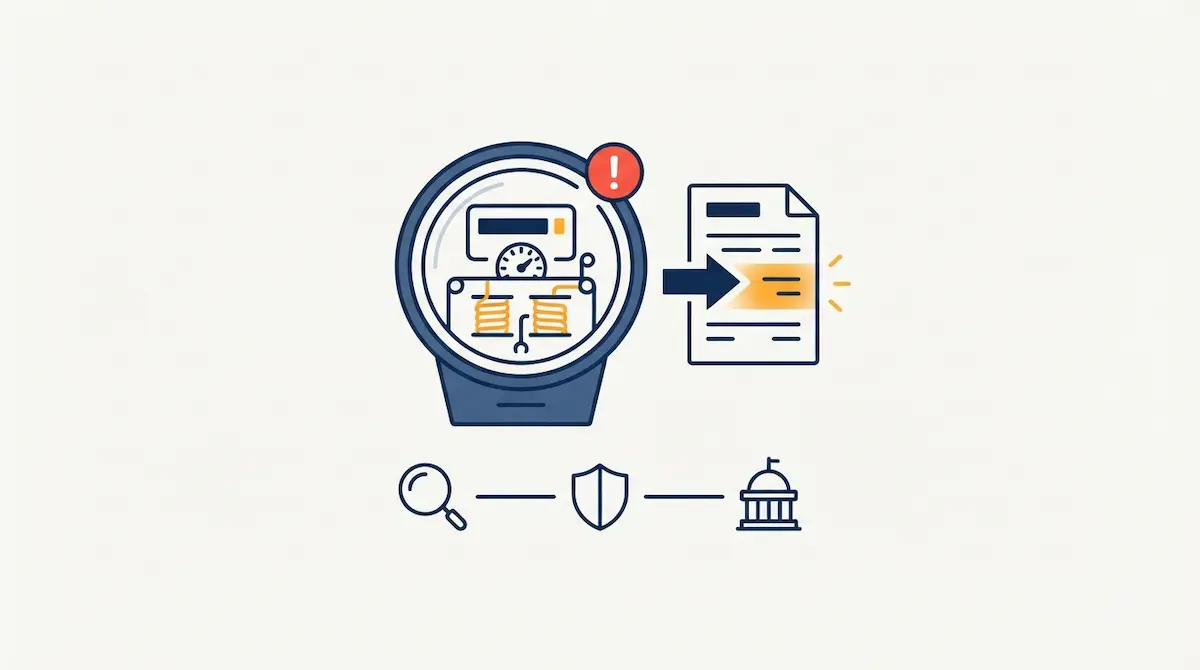
A MEPCO detection bill is an extra charge added to your monthly bill when the company concludes that units were used but never recorded. It is not taken from your meter reading. It is an estimate — and the NEPRA Consumer Service Manual (CSM) caps how far back that estimate may reach.
Detection bill or supplementary bill?
Two different causes sit under one nickname, and they follow separate rules.
Metering fault — slow meter, dead phase, defective CT, or a multiplying factor MEPCO forgot to apply. Governed by CSM Chapters 4 and 7. Correctly called a supplementary bill.
Dishonest abstraction — direct hooking (kunda), tampering, a shunt or loop on the terminal box, a bypassed or missing meter. Governed by CSM Chapter 9, alongside an FIR under the Pakistan Penal Code.
Read which one your notice names. A slowness bill labelled “detection” is charged under the wrong clause, and the ceilings differ sharply.
How far back MEPCO can charge
| Cause | Maximum period | Clause |
|---|---|---|
| Meter slowness or defectiveness | 2 billing cycles | 4.3.3 |
| Skipped multiplying factor, MDI, tariff differential, power factor penalty | 6 months, raised within 1 year | 7.5.5 |
| Theft — registered consumer | 6 months | 9.1.3 |
| Theft — unregistered consumer | 12 months | 9.1.3 |
The two-cycle limit has survived a challenge. GEPCO took it to the Supreme Court (Civil Petition 691 of 2020); the Court remanded the question to NEPRA on 17 May 2023. NEPRA’s decision of 13 June 2024 kept the two-cycle cap and directed distribution companies to take disciplinary action against officials who fail to replace slow meters within it.
MEPCO has already been held to this. After a show-cause notice under the NEPRA (Fine) Regulations 2021, MEPCO’s own returns showed 222 consumers charged for slowness — some for eight to twenty months. By Order dated 10 April 2025, 204 of those bills were revised, the units charged fell from 2.1 million kWh to 0.181 million kWh, and 59 officers faced departmental action.
Check the calculation
For an unregistered connection, MEPCO applies:
Detection units = Load × Load Factor × 730 × Months
For a registered consumer, that formula is the last option, not the first. Clause 9.1.3 sets the order: previous consumption and billing history first, then future undisputed consumption, and only then the formula. Units already billed to you during the same period must be deducted — a step that is routinely skipped.
Compare the sanctioned load printed on your bill against the load used in the working. Then count the months charged against the table above.
Evidence to demand in writing
- Meter reading snapshots. Clause 6.1.3 requires MEPCO to keep twelve months of them for production before NEPRA, the Provincial Office of Inspection, or a court. Since the 2025 revision, each must carry time-stamping and geo-tagging.
- Discrepancy book entry. Under 6.1.4, meter readers must record faults when they take the reading.
- M&T inspection report and data download report.
- Written notice before on-site testing, required by 4.3.3.
If MEPCO cannot show a discrepancy entry for the months it now bills, the delay was theirs. NEPRA’s Complaints Resolution Committee applied that reasoning on 12 September 2025, cutting a Rs 20.75 million LESCO detection bill from sixteen months to six.
Also read: MEPCO Smart AMI Meter Rollout 2026: What to Expect
Challenge the meter
Pay the meter challenge fee under clause 4.3.4 — Rs 500 single-phase, Rs 1,000 three-phase. MEPCO must then test within seven working days, in your presence. A fast meter is replaced at MEPCO’s cost with credit for two cycles; a slow one is charged for two cycles only.
Clause 4.3.5 gives stronger cover. Notify MEPCO in writing that you have asked the Electric Inspector to test the meter, and MEPCO cannot remove it until that test happens in front of you. The Inspector must test within one month, and any debit is capped at two months.
Where to escalate
MEPCO first. Written application to your SDO, then XEN. Keep a stamped copy — NEPRA will return your case if this step is missing.
Electric Inspector (Provincial Office of Inspection). Meter-correctness disputes fall here under Section 26(6) of the Electricity Act 1910. Multan region: 061-6771499. Bahawalpur region: 062-9250444. Complaints also go through the Punjab Energy Department’s billing portal at ebcp-energy.punjab.gov.pk.
NEPRA. Complaint under Section 39 of the NEPRA Act 1997, through the CAD complaint system. Cases older than one year must go in writing to the DG Consumer Affairs. Regional office: Office 20-22, 3rd Floor, Bomanji Square, 84/2 Nusrat Road, Multan Cantt.
Wafaqi Mohtasib. MEPCO is a listed agency; no fee, no lawyer.
Keep your supply connected
Clause 8.2.9 protects a consumer who has filed with NEPRA and obtained restraining orders — provided current bills keep being paid. Pay the undisputed portion of every bill while your case runs.